Thursday, January 16, 2014

On Klimt and Schiele, Schiele and Klimt

The Leopold Art Museum in Vienna is a monumental, classical building in the midst of monumental classical buildings, solid and imposing among Vienna's tributes to the Hapsburgs, to the Enlightenment, to itself.  The square asserts its calm power, but inside the Leopold the less respectable paintings of Gustav Klimt and Egon Schiele are on display.
Klimt, Death and Life
Klimt, The Kiss
          In the first two decades of the 20th century, a span of time that ended disastrously for Austria with the Great War and collapse of the Hapsburg Dynasty, Klimt and Schiele painted their unsettling body of work.  Klimt was the older by almost 30 years, Schiele his brilliant protégé.  They died within ten months of each other, in a 1918 that marked the vanishing of a generation, the end of the Austro-Hungarian Empire, and a change in temperament and world-view that one might say ushered in the Modern Age.  At any rate, the world changed forever, and Klimt and Schiele did not survive the change. The paintings, of course, survived magnificently.  Klimt's work is a triumph of composition and repose, of the filled canvas and disturbing undercurrent—sometimes hardly an undercurrent, as in his 1915 Death and Life, which you can see at the Leopold.  There is a compression in his imagery that is almost claustrophobic: his Kiss (at the Belvedere rather than the Leopold, but famous in his body of work) seems to flatten the image of its couple, calling attention to its own two-dimensionality and rendering the kissing couple bunched and uncomfortably tangled.  In both cases there's hardly a space to breathe in the composition: Klimt smothers the eyes with pattern and paint, and standing in front of these paintings feels like a surfeit, as though it is all too much, as though Klimt is trying to strike the beholder with a decadent abundance.  The paintings are beautiful in design, color, and form, but it is uncanny beauty in that the familiar images are made strange by their sheer lushness.


          Schiele's paintings, on the other hand, are aggressive,  confrontational.  Imprisoned for "pornographic drawings at the height of a controversial career, he strikes alliance with the marginal, the outcast, the insane.
He has as many self-portraits as, say, Rembrandt (who is famous for self-portraiture), but where Rembrandt mercilessly records his own decline from strapping young man to a paunchy old age, Schiele doesn't live long enough to show us an aging artist.  Not that such a subject would interest him, his portraits glaring at you with a kind of sudden, surprising menace, as though his head has just popped into the frame to look at you in defiance.  Self-absorption?  Hardly.  It's more a mapping of the inner landscape, a projection of raw emotional menace. There's almost the Taxi Driver challenge ("You talking to me?") in his expressions, like his gaze is disrupting the "fourth wall" of the painting and staring back at you like some peeping tom, some intruder perched at the edge of your soul's privacy.

Schiele, Self-Portrait, 1912
         They're at poles, Klimt and Schiele, mentor and student, friend and friend.  Klimt takes what you expect of painterly beauty—color, form, composition—and makes it subversive, undermines it by making it too much.  Schiele challenges the eye, dares a response, looks right back at you.  Subversion and defiance, then.  Things that I like for art to do.  Because, to me, art shouldn't necessarily affirm our best images of ourselves.  Shouldn't show us just what we wanted to see all along—whether what we wanted to see is a hipster conformed non-conformity or Neo-Classical buildings congratulating themselves for their solidity and balance and power.  My favorite art is uncomfortable.  It teases you, undermines your easy intentions, cusses in church and looks right back at you so that you can't hide the fact that you're looking.  It's the disrespectable painting on the second floor of that most respectable building, drawing the light into itself and making the still air of the museum quiver with its energy, or yours.  Text ©2014 Michael Williams

Sunday, January 12, 2014

On the Sala Terrena, Freud's Study, and the Dissonances of Mythical Realism

Yes, Vienna unveils itself to the traveler.  Sometimes the revelations are subtle—hardly revelations at all—and other times they slap you in the face and make you wonder what you were thinking before they slapped you.  In my own experience, though, insight comes in a kind of cloudy middle ground: there are things to see, but you have to be expecting them to see them with any clarity.
Two small buildings, then, in Vienna.  The Sala Terrena and the Freud Museum.  Two different kinds of pilgrimage brought us to two different places, and the results are some thoughts on "mythical realism" as well as the places themselves.
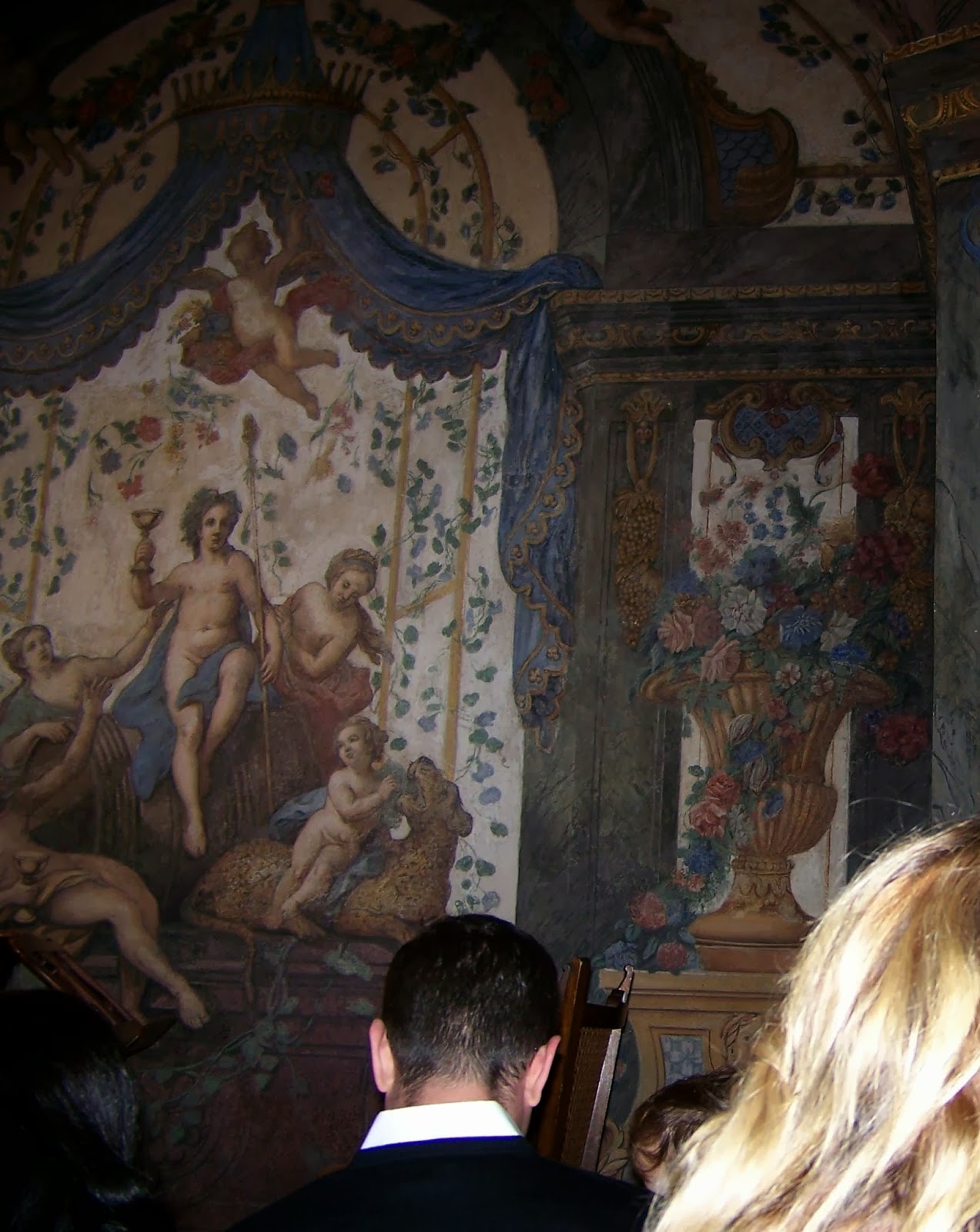
The Sala Terrena is in central Vienna, nested off a little courtyard and difficult to find.  It was part of the Monastery of the German Teutonic Order, a name that conjured unsettling associations to me—like anschluss or lebensraum—but turned out to be more innocent, an 18th century chamber in the House of the Teutonic Knights.  Mozart lived on the premises, and performed in the Sala Terrena, when he was first brought to Vienna by his Salzburg employer, Archbishop Colloredo.  It was a prelude to the two men's falling out, as Mozart's sizable ego (not uncommon in artists, and apparently pretty extravagant in Mozart) ran up against the Archbishop's paternalism and condescension (not uncommon in the way patrons treated the artists they employed, and especially the case with Colloredo, it seems).  The falling-out that ensued (Mozart lived there only two months) unmoored the young composer and turned him loose in Vienna's almost infinite range of musical possibilities, and the rest is cultural history.  The Sala Terrena still hosts chamber music concerts, which is what brought us there on that December night.  Dionysus, Liebe Augustin, and pseudo-Renaissance nudes in their 18th-century versions look down on you as you listen to a good but uneven quartet (in Vienna, better-than-average musicians are excellent for other cities in the world), dressed in cheesy Enlightenment costumes, playing Mozart and (on the night we attended) a little Bach
The Freud Museum is a little further from the older city center, easy to find and clearly marked on the Berggasse.  It has a simpler story, being the home of Freud's Vienna offices from 1891 until he left for London in 1938 under the specter of the approaching Nazis (this time Anschluss applies).  He wrote almost all of his major works while housed on Berggasse, and conducted his private practice from these rooms.
You would think the places had little in common, and in many ways, you would not be wrong. The exuberant Venetian Renaissance excesses of the Sala Terrena contrast strikingly with Freud's now-spare, almost minimalist offices.  But compare my photograph (taken surreptitiously at the Sala, where photos were discouraged) and this old picture of Freud's desk as it appeared in the 1930s, taken by Hungarian photographer George Brassai.

The old gods are impossible to shake.  Nietzsche held that the gods were the shapes we gave to the blind, inscrutable forces of the Will.  Jung wasn't really that far from reaching the same conclusions: for him, the gods were the shape we gave to large, irresistible forces in our subconscious—impulses, syndromes, psychological complexes (yes, I know Freud is probably spinning that I would bring in Jung to talk about his offices, but there you go!).  In both cases, side by side with established orthodoxies—Dionysus dancing in the consecrated premises of the Sala Terrena, totems and statues of the gods on Freud's desk in his offices—the ancient figure underlie, critique and mock the religion du jour.  The old gods persist, because they are the keepers of story, and story is a way (perhaps the way, but maybe that's just a writer talking) we define our theologies.  In the chairs of the Sala Terrena, listening to Mozart's "Dissonanzen Quartett", or seated in Freud's waiting room amid the stripped-down monuments to the religion of the subconscious, mining the dissonances of our own souls, the gods watch us as we watch other things, and it's only now and then that we have a glimpse of how, in the very depths of ourselves, all these worlds connect.

Tuesday, January 7, 2014

On the Veils of Vienna

Vienna imposes upon your eyes, a cityscape that weds beauty with a raw display of Enlightenment power.  Its core architecture is all about the Hapsburgs, from the imposing buildings at the city center all the way out to the Schonbrunn Palace (see the photo), which is by far the most ostentatious private residence I can imagine.  All to do with Austria's ruling family and their centuries-long display of manufactured majesty.
        Vienna is a city, then, nested in cities, with a lengthy history of spilling over its walls, then rebuilding walls to accommodate its growth.  What this did in Vienna was transform a central city into a kind of warren,  where alleys that are more tunnels than alleys open into squares small or grand, ringed by Italianate buildings, magnificent ones from the 18th and 19th centuries side by side will more approximate ones—reconstructions from Vienna's post-WWII salvage, when the housing need was great and the finances strapped, and yet the city's mind, still deeply conservative as Vienna almost always is, tended toward facsimiles of the older structures that were still standing, distinguishable from the older counterparts by a kind of inattention to detail and nuance, settling for living spaces over architecture because they had to, because the finery of the old things didn't make sense like it used to.

       
And therein lies Vienna, dragged kicking and screaming into each century, embodiment of that simple but great conservative insight that moving forward leaves not only bad things behind but good ones.  That the impossible family ego that accounts for the size of Schonbrunn and its rooms on rooms within rooms accounts also for the impossible grandeur and beauty of the place.  I was thankful that the politics of post-war Vienna were so fluid and chaotic, so that Soviet architecture did not create a drab "workers' paradise" like the ones on the Budapest outskirts.  Between and among its elegant older buildings and its well-intentioned but more pale restorations, Vienna lifts curtains and reveals itself like a graceful, aging, fairly decadent fan-dancer.  The steeple of St. Stephen's (perhaps Vienna's central church) vaulted up into the darkness, half-obscured by December fog, impossible to photograph, as though it promised only a temporary glimpse into the past that shaped this city, as though the camera was only allowed to catch the play of light along its edges like an enormous and guttering torch in the night sky.  At one time, no doubt, that steeple was introduced to a city skeptical of change; it was resisted, maligned according to standards of ugliness we would no longer recognize, then somehow the city grew accustomed to it.  It is the way things were and are in Vienna, and I wonder what the inevitable objections were, but also what the church replaced in a city that changes so slowly, but changes nevertheless.

Thursday, January 2, 2014

On silence and slow time in Budapest

We spent the first 24 hours or so in Budapest without seeing a clock—at least one that worked.  There were no clocks in the hotel room, and only when we were checking out at the end of our stay did Rhonda notice the clock above the hotel desk, cleverly disguised as a red satin pillow, as though subordinated to some kind of Late Bordello décor.
                In the meantime, the one clock we had seen clearly was the one in this photo, far up on the Castle Hill in Buda, right across from the Matthias Church and atop one of the few buildings not leveled by the firefight between the Nazis and the Soviets in the siege of the city.  According to our guide, the Hungarians loved this clock not only for its survival,  but also because until several years ago it had stopped running entirely.  There it was, a frozen relic of the city's endurance, described with a kind of amused affection by this smart, educated Hungarian who was showing us around the town.
                So, why the fuss over a stopped clock?  Or better yet, why the delight in its "silence and slow time"—a phrase from Keats about his Grecian Urn, also famous for its pause and stillness?  Are there ways, perhaps, in which the clock was not silent at all, that it gave us a take on both time and survival and how they fit together?  More than once, our guide waxed humorous over Hungarian, Russian, and (most acidly) Soviet time-wasting and disorganization.  No doubt he was playing to the crowd in assuming our dislike for the Soviets (his own was deep, and given his country's history, understandable), but it was interesting how charitable he was to what he saw as Hungarian inefficiency.  It was a kind of, "we're casual, but that's the way we are" attitude, and the Soviets were far worse—both inefficient and authoritarian.
                I've read somewhere that the minute hands on clocks were added late in the 15th century at the insistence of merchants' guilds in order to determine more precise times for work hours, deliveries, and meetings.  But the first working clock we saw in Budapest was in a place where it would seem that relaxation trumped efficiency—the city's famous Szechenyi Baths, atop the Art Nouveau locker room/community building, clearly visible from the middle of the hot springs pools.  Rhonda and I went there on a frigid Thursday, mainly because so many people had encouraged us to do so, though I thought that hopping out of 90 degree water into 30 degree temperatures sounded like a terrible idea at the time.  You'd wonder why a clock was so prominent in a place of relaxation until you read the signs—in English, French, and German, as well as the Hungarian—cautioning that it was wise to stay no more than twenty minutes in the hot water. 
                 A clock, then, whose operation was not only crucial but medicinal.
                Of course we overstayed the water's welcome, not only seduced by the heat, but also welcoming the contrast to Budapest's prevailing December damps, made more dismal, it seemed, because you got the readings in Celsius, and single digits are by nature colder than double.  We were teased out of thought, as Keats would say in the same poem. Duly warned, though, by numbers we could understand atop the functional clock, we were seduced by a kind of eternal present, knowing that time was dutifully passing as we lay in hot water doing nothing.  We emerged from the baths weak-kneed and good for nothing else that evening, having lulled ourselves into holiday, but reassured by the security of measurements that there was still a time we were passing, perhaps wasting, but that the numbers on the clock were little more than abstractions by which we steadied ourselves in uncertain country.

Tuesday, December 31, 2013

On Budapest Arrivals

This the first entry of a number from central Europe, from a trip we took almost on impulse and for which I am thoroughly grateful.  Here, though, is how it began.

After a number of delays, the most frustrating of which was the drag through London Heathrow, Rhonda and I touched down at the first destination of our trip.  Relieved to be off a plane for the next ten days, we found ourselves at the Liszt Ferenc International Airport in Budapest. 
                The plane had taken us over huge, scudding clouds—sure sign of the storms that were beginning to brew over the Atlantic and would hit Ireland and the U.K. pretty hard over our visit to the continent.  Yet above the cloud cover the sky was wintry blue—a color so bright and pale that it seems you would find it on ceramics rather than in the sky.  And that was only the beginning of the strangeness. All around us the incomprehensible consonant-twisting of Hungarian that made me realize how much we would be at the linguistic mercy of our hosts. 
My second languages, you see, are dead and buried—Latin and Old English—and yet they avail in so many circumstances.  I speak very little Spanish, but can understand more of it, as I can Italian and French.  Thanks to the Teutonic roots of the Old English, I can read enough German to go the right way on a one-way street and recognize which bathroom is for the men.  But I had no handle--absolutely none--on Hungarian, so I began by thinking that we would start in the most estranged and "foreign" of the cities we planned to visit—or, better said, in the city where we would be most estranged and foreign.
Budapest was the last choice I made on the cities we would visit—a choice made largely on convenience and expense.  On both counts it had seemed better than, say, Berlin or Warsaw, but I was beginning to have my doubts as our cab raced through industrial stretches of Late Soviet architecture on the way to the city center.  I expected guards in ushankas,  spotlights, defecting gymnasts.  But of course, it was nothing like that where we were headed, as I found in daylight.
Budapest, certainly at its center, has been largely restored over the last seventy years.  The Germans and Russians trashed it in the last winter of World War II, and you are hard pressed to find a building that remained undamaged.  That includes the castle, the Parliament, and the famous Fishermen's Bastion.  After the war, the landmark buildings were restored, with limited funds but to the old designs, using archival materials to guide the reconstruction.
The result is a mixture of beauties, a Parliament building that is breathtaking and a Fishermen's Bastion which, although pleasing to the eye, struck me as somewhere between a gothic structure and a Disney castle.  And yet even that cobbled arrangement had something urgent in its design, as though if you didn't raise it quickly and right, something would be lost forever.
It was T.S. Eliot who said, "These fragments have I shored against my ruin".  It was the people of Budapest who shored their own fragments by a careful attentiveness to what had gone before, to what they remembered.  It had to have been foreign to them—their homes flattened, the Soviets all over them and settling in to stay for fifty years—but what they managed to do along the Danube, guided by memory and archive, was to reconstruct an old identity out of guesswork and hope.  You can see the seams between buildings, the difference in a ground floor that remained intact and the facsimile upper stories: nothing quite connects like it did in, say, the 1920s, but things have been connected in honorable and lovely ways. 
After all, the architects of old gothic cathedrals shored fragments by considering no work complete.  Each building was a slow accumulation of what had gone before, a trust in the imperatives of both tradition and change.  On a foggy day, like our first full day in Budapest, you could stand on the ramparts of Buda and look across the river at the government buildings of Pest, glimpsing them as you can in my attached photo, as they seemed to take shape in a fog that hovered between settling and breaking.

Thursday, August 8, 2013

On Taking Refuge


Two weeks ago, Rhonda and I were up at the Ten Thousand Buddhas Summit Monastery, a secluded and beautiful site about fifteen minutes from our house in Corydon.  We were there at the invitation of the Reverend Thich Hang Dat, at a luncheon in honor of Mayor Greg Fischer's visit to the monastery.  For those of you outside our area, that's the Mayor of Louisville,  Rhonda's ultimate boss in Louisville Metro.  

We were at the event independently (i.e. not part of the Mayor's entourage) but we sat at the same table with him and Rev. Hang Dat—very pleasant company among two engaging and intelligent community figures.  Rhonda knows the Mayor, of course, and though I can't claim more than a passing acquaintance, I think he's a good man and a good mayor.  Before things settled in for the luncheon, he asked us, "Are you Buddhists?"

And hence the subject of the blog.

Rhonda gave a longer and very thoughtful answer to the question.  Like a good Catholic girl (and I mean that description in the best sense possible) she said that no, we weren't Buddhists, but that we were drawn by the spirituality and kindness of the tradition, especially as we saw it in display among the people in the Summit Monastery's community.  We've been there a few times, she informed the mayor, and always come away with a sense of welcome and hospitality.

There was nothing in that answer with which I disagree.  Mine would have been shorter: to the mayor's inquiry as whether I was a Buddhist, I would have to say, simply, "Not yet."

As I understand, to become an "official card-carrying Buddhist", one "takes refuge" in  1) a belief in the Buddha's enlightenment and example to those who seek their own enlightenment, 2) a belief in the dharma (the basic Buddhist teachings), and 3) an embrace of the sangha, the Buddhist community of faith.  As of now, I'm inclined toward taking refuge, though I'm spending some time in mindful consideration of what is an enormous spiritual step.

The meditation I've been doing, under the guidance of Rev. Hang Dat and (of course) on my own, is a practice that is already bearing enormous psychic rewards: if I go no further into Buddhism than simply meditating morning and evening and being more mindful in the way I pass my days, that alone will make this experience worth my while in abundance.  I am very new to meditation, but already notice an equilibrium and focus that I've experienced only at moments before, and certainly never in a daily, sustained fashion.  I have a feeling that if I am observant, I'm pushing the second heart attack out of the way and enabling emotional and physical health.  Those are good things.

The rest of the bargain I'm puzzling through.  And here are some of the issues.

I've never been a believer in a personal God, which is the kind of deity that most of my Christian and Jewish friends profess.  I tried to be for fifty years, because I can remember distinctly not believing when I was about four or five, feeling awful then as though something was really wrong with me, and masking the disbelief with excuses, compromises, false professions of faith.  Folks, I did this for half a century—partly because I feared facing the distance and disfavor of some people around me, but not so much that as something else: a kind of residual fear like the one in the old Blood Sweat and Tears song…to myself, I swore there was no heaven and I prayed there was no hell.  I respected and even envied the faith of some of my friends, especially when I saw it give life and breath to their actions, and even more so when I saw it emerge from an intellectual and emotional vigor I respected.  That faith was apparent to me in a few of the people I knew, and it was probably at work where I didn't see it in others.  I always respected it (except for about a 3-year period in late high school and early college, but nobody respects anything at that time, so I apologize to you and forgive myself in one fell swoop for that particular irreverence).  

Buddhism has a wide range of belief on this issue.  The Buddha himself never talked much about metaphysics, and there's that wonderful metaphor of the arrow in one of the sutras, which in short says that if you're shot with a bow, the first thing you think of is how to tend the wound rather than who made or fired the arrow.  I really understand this: metaphysical ultimates are so far beyond my grasp that I have to leave the jury out.  If you know the essential truth and ground of your being, again I envy you because I don't.  What I do know is that it makes sense to live the happiest and most mindful life you can, for yourself, for those around you, and for the community of living creatures at large.  When the time comes to answer for that, I hope to do so without regret or reservation.  It's making a beautiful thing of the here and now, tending to the well-being of others as well as of yourself.  I think that's the heart of the good life in most religious traditions: if we learned it from some divine and ultimate source, evolved it as an idea of the best way to live with each other, or whether it was a combination of these things or something else entirely, I have no idea. 


But I do know this.  If you believe in that kind of living and don't subscribe to a Christian theology, then you're pretty much out to lunch with many Christians.  If you don't buy the metaphysics, you fall grievously and eternally short.  In other words, if you swear there ain't no heaven, you get the hell you've been praying all along doesn't exist.  It's clear cut, either/or, and it still scares me.  Not that I've found out what to do with that fear.  But Christianity tells me that what I should do with it is to believe something I don't believe.  The idea of hell scares the hell out of me, I know it's residual from childhood when it was stoked by being afraid that I couldn't believe what everyone around me seemed to believe, and it's strange how something so early and primal stays with you, like the tattoo you got when you were drunk.  


Is such a fear a sign that somewhere, deep down inside me, I believe some early teaching I have since forgotten?  Maybe or maybe not.  I don't believe that a fear of hell is the only thing on which I can base a worldview, because a worldview born out of fear strikes me as brittle, miserable, and ultimately weak. So is a worldview born of exclusion, and as much as I love the commitment and dynamism of some Christians I know, I get a little exasperated when others circle the wagons.

I know, I know…Buddhism (or some Buddhism, or most) has the whole thing of reincarnation.  Something that a skeptic finds a little out there, a little hard to believe as well.  But here's the thing about that.  The life Buddhism sets before one who takes refuge may have a past, but it is not contingent on the past—whether your own or a previous life you've lived, or even whether you lived that previous life in the first place.  It's about the mindfulness of now, the intensification and deepening of the time you have, and of finding a way to share that kind of poetry with others.

This time next year, if I see the mayor and he asks that question again (as well he might, because when you meet so many people, how can you keep track of what you've said to each one?) my answer may be the one Rhonda gave, the one I give in this writing, or something altogether different from both or either.  It will be, however, the fruit of thought and mindfulness and meditation, and of the gratitude for brushing against a tradition every bit as ancient and profound as the one that I've never quite grasped, even though I wanted to.  It took fifty years to find Buddhism, and whether it's a destination or a way station on the road, I wanted my friends to know I'm spending some time exploring the surroundings.

Friday, August 2, 2013

Game of Thrones: So far, so...far?

Like the late arrivals we often are, Rhonda and I are just now watching the first season of HBO's Game of Thrones.  I happened to luck into a remarkably bargain-priced set of the DVDs at our local Joe's Records, and picked them up because many of you have recommended them, because they're high fantasy, and since I started my writing career working in that genre….well, you know the rest.

My reaction to the show has been mixed favorable.  The acting, the production values, and the Northern Ireland sets are, to my way of thinking, pretty wonderful.  I've liked Sean Bean for ages, it seems, and having him anchor the cast is, to me, one of GOT's  principal strengths. 

But hold on a minute.  Does he really anchor a cast or is he just one among a helluva lot of people—so many that I'm finding myself looking at the guide in the DVD set because I can't tell the players without a scorecard?  Baratheon mingles with Stark and Lannister (there are also the blonde ones whose name eludes me—super-entitled wicked brother, gradually empowered sister) until  I find myself stopping the disc, tottering on the edge of lost until I piece together who's who, the image frozen on the screen.

This is digital narration rather than the television or the film I grew up with, so I am forced to scramble a little—not a bad thing for a budding geezer.  It's the kind of "cast of hundreds" you can pull off if your last name is Tolkien or Tolstoy, the leniency of prose fiction allowing the reader to backtrack and cross-reference.  But I'm not as used to it in film or video, and GOT is asking me to access the story in a way that's relatively new to me.  And I'm grateful for that gauntlet being thrown down, for something asking me to venture into unfamiliar realms of "reading".

Having said that, I'd really like to see the elements of the fantastic more in play in the series, fulfilling some of the stark (pun intended) promise of the first few minutes.  We're on the eighth episode, and it seems to be returning, but that's a long time to wait.  The preternatural lurks at the margins of the narrative, and we glimpse moments of it, but it's almost as though it's an afterthought, a kind of hood ornament on the far-ranging Byzantine intrigue.  Whatever one can say about Jackson's Lord of the Rings (and I've heard ranging opinions, from loving to loathing), the fantasy is integral to what happens on screen.  I also found it far easier to tell one character from another, but I'm not reliable on that, since I know LOTR better than any book other than my own, and leaned on that knowledge as I watched the movie.  People who were introduced to Tolkien via the Jackson films might well have found some rough going in growing acquainted with all the characters, but the film (and Tolkien's novel) have the advantage of convening the whole bunch at the Council of Elrond, so that their dispersal becomes easier to follow in the last two books of the trilogy; GOT, on the other hand (at least the TV series—I can't speak for the novels, though I suspect they do the same) moves its characters from distant sources toward convergence, so that the advantage of contrasting one dirty-haired Boromir-type with another goes clean out the window, and I've been looking at them as family members rather than individuals in order to tell them apart.

Something else, though, has always set apart fantasy from other modes of storytelling—especially the high fantasy version of the genre.  We often laugh about how many high fantasies involve the "rag-tag group who save the world from ultimate evil" but they do this because high fantasy deals in the Big Idea, the quest, the important issue, and rests on the premise that ultimately, the world is worth saving.  Martin's Westeros is up for grabs, and I have yet to get a sense of what's at stake beyond raw plays for power, and I am, as I said before, eight episodes in.  That's 4/5 of Season 1.

And this bothers me.  In high fantasy, the stakes should be high for everyone involved, and I get the feeling that these intrigues at the uppermost levels of fantasy politics will make little difference to those who live day by day in Westeros, something you wouldn't have said about the events that take place in Middle Earth or Earthsea.  Maybe it's high fantasy with the postmodern turn of "no grand narrative"?  If that's the case, I suspect I'm going to feel cheated ultimately, like in so many postmodern stories: shimmering surface gives way to a kind of self-referentiality, a kind of brittle thinness.


All in all, the attempt to set down the War of the Roses or Jacobean intrigue in the midst of an alternative world may or may not end up successfully; I'm suspending judgment and enjoying the sumptuous visuals, the neat suspense of the self-contained episodes, and not yet worrying my pretty little head about a more nagging concern: the lack of a grand thematic design of the whole work (so apparent in Tolkien's books and in Jackson's film version of them).  Grand design is something I like in heroic fantasy, just as integral to the genre as the preternatural mythic stuff; however, I'm beginning to fear that, once you get beyond the dark visual beauties of George R.R. Martin's Westeros, it'll end up being kind of like Gertrude Stein's Cleveland, in that "there's no there there".